Master in Agentic AI: Building Autonomous Systems, Protocols & Workflows
Course Overview
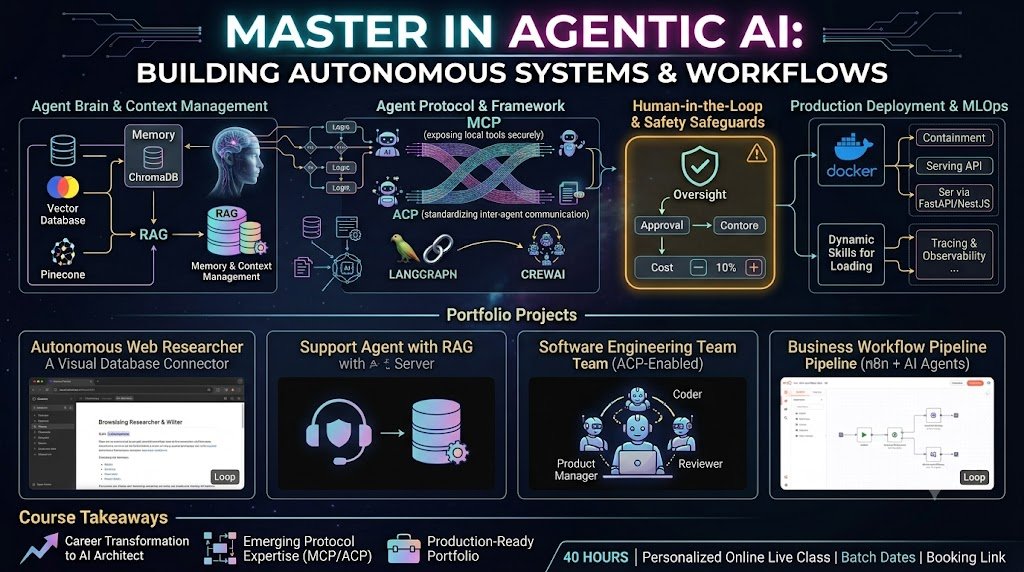
Agentic AI is shifting technology from passive assistance to autonomous execution. This hands-on, project-focused course covers everything from foundational concepts to architecting multi-agent systems, protocol engineering (MCP/ACP), modular skills development, and deploying production-ready AI workflows that automate complex real-world software and business tasks.
Core Course Highlights
- Hands-on & Project-Driven: Build functional AI agents, plugins, and custom MCP servers from early modules.
- Modern Stack: Work with Python, PyTorch, TypeScript, LangChain/LangGraph, AutoGen, CrewAI, and n8n.
- Protocol & Extensibility Focused: Master Model Context Protocol (MCP), Agent Communication Protocol (ACP), custom skills, and plugin architectures.
- Production & MLOps: Deploy multi-agent systems with FastAPI/NestJS, Docker, observability tracing, and human-in-the-loop safeguards.
Duration: 40 Hours |
Prerequisite: Designed for Developers, Tech Leads, and Software Engineers (Basic Python/JavaScript knowledge helpful).
Class Type: Online Live Class | Class Mode: Personalised
Class Type: Online Live Class | Class Mode: Personalised
Complete Course Modules
Module 1: Foundations of Agentic AI & Extensibility
- Architecture of an AI Agent: Brain (LLM), Memory, Planning, Tools, and Extensions.
- Deterministic vs. Autonomous Execution.
- Prompt Engineering for Tool Calling, Structured Outputs (JSON/Pydantic), and Function Calling.
- Agent Extensibility Standards: Understanding protocols vs. hardcoded API integrations.
Module 2: Memory & Context Management
- Short-term vs. Long-term Memory in Agents.
- Vector Databases (ChromaDB, Qdrant, Pinecone) & Retrieval-Augmented Generation (RAG).
- Managing Large Context Windows (Gemini/Claude strategies), Summarization, and State Persistence.
Module 3: Developing Custom Skills, Plugins & Tools
- Connecting Agents to External APIs, Databases, and Web Browsers.
- Building Custom Skills & Modular Plugins: Creating decoupled, hot-swappable agent capabilities in Python and TypeScript/JavaScript.
- Plugin Architecture: Manifest files, schema definition, runtime skill injection, and dynamic capability loading.
- Error Handling, Tool Selection Logic, and Fallback Strategies.
Module 4: Protocol Engineering (MCP & ACP)
- Model Context Protocol (MCP): Developing custom MCP Servers and Clients to expose local databases, file systems, and tools securely to LLMs.
- Agent Communication Protocol (ACP): Standardizing inter-agent communication for message passing, task delegation, and state sharing across different runtime environments.
- Hands-on Lab: Converting legacy REST APIs into standard MCP resources and tools.
Module 5: Agent Frameworks & Orchestration
- LangGraph: Graph-based, stateful multi-agent workflows.
- CrewAI & AutoGen: Multi-agent collaboration, role specification, delegation, and ACP-driven inter-agent messaging.
- Low-Code Automation: Integrating agents and custom plugins into visual workflows using n8n.
Module 6: Autonomous Planning & Reasoning
- ReAct (Reasoning + Acting) Framework and Plan-and-Solve Strategies.
- Self-Reflection, Critique, and Iterative Self-Correction.
- Handling Non-Deterministic Outputs, Edge Cases, and Protocol Failures.
Module 7: Human-in-the-Loop & Safety Safeguards
- Designing Approval Steps for High-Risk Actions (e.g., write/delete operations via MCP).
- Security Best Practices: Prompt Injection Defense, Data Privacy, and Plugin Sandboxing.
- Rate Limiting, Cost Controls, and Token Monitoring.
Module 8: Production Deployment & MLOps
- Serving Agents, MCP Servers, and Custom Plugins via REST/gRPC APIs using FastAPI or NestJS.
- Containerization with Docker and Deployment to Cloud/Edge environments.
- Observability and Tracing using LangSmith, Phoenix, or Arize for tracking tool calls and protocol interactions.
Portfolio Projects
- Custom MCP Server & Plugin SuiteDevelop a production-grade MCP server that securely exposes local databases, system telemetry, and custom developer tools directly to frontier LLMs.
- Autonomous Web Researcher & WriterAn agent using dynamic skills and web-browsing plugins to synthesize complex information, verify sources, and output structured reports.
- Multi-Agent Software Engineering Team (ACP-Enabled)A collaborative crew of agents (Product Manager, Coder, Reviewer, Tester) communicating via ACP to autonomously write, review, and test software modules.
- Automated Business Workflow Pipeline (n8n + MCP Agents)An end-to-end workflow agent leveraging n8n, custom plugins, and MCP connections to monitor inbound communications, process data, update databases, and execute actions.
Duration: 40 Hours |
Prerequisite: Designed for Developers, Tech Leads, and Software Engineers (Basic Python/JavaScript knowledge helpful).
Class Type: Online Live Class | Class Mode: Personalised
Class Type: Online Live Class | Class Mode: Personalised
Course Takeaways & Student Outcomes
Upon completing the Master in Agentic AI course, students will graduate with the practical skills, system architecture knowledge, and hands-on experience required to build and deploy autonomous AI systems.
Here is what they will walk away with:
1. Hard Technical Skills & Framework Mastery
- Protocol & Extension Engineering: Ability to build and expose custom MCP (Model Context Protocol) servers and configure ACP (Agent Communication Protocol) for seamless inter-agent interaction.
- Modular Plugin & Skill Development: Expertise in creating decoupled, hot-swappable plugins and dynamic skills in Python and TypeScript/JavaScript.
- Multi-Agent Orchestration: Practical mastery of leading orchestration frameworks including LangGraph, CrewAI, AutoGen, and low-code platforms like n8n.
- Vector Databases & Memory Systems: Experience implementing short-term/long-term persistence, custom state management, and hybrid search using tools like ChromaDB, Qdrant, and Pinecone.
2. Enterprise System Architecture Capabilities
- Autonomous Reasoning & Self-Correction: Capability to design agents that use ReAct frameworks, plan-and-solve strategies, self-reflection, and automated loop debugging.
- Production Deployment & MLOps: Skills to containerize AI applications using Docker, serve agentic APIs via FastAPI/NestJS, and manage tracing/observability using LangSmith or Phoenix.
- Guardrails & Security: Understanding of human-in-the-loop workflows, prompt injection defenses, tool sandboxing, and token/cost optimization techniques.
3. Production-Ready Portfolio
Students will graduate with four fully built, functional portfolio projects ready to showcase to employers or clients:
- Custom MCP Server & Plugin Suite: Exposing local databases and developer tooling directly to LLMs.
- Autonomous Web Researcher & Writer: Multi-step browsing, synthesis, and structured report generation.
- ACP-Enabled Software Engineering Crew: Collaborative multi-agent team (PM, Coder, Reviewer, Tester) executing automated dev cycles.
- n8n + MCP Business Automation Pipeline: End-to-end automated workflow for processing inbound communications, database updates, and action execution.
4. High-Impact Career & Business Capabilities
- Transform from Developer to AI Architect: Shift from writing manual code or using standard LLM prompts to engineering autonomous, self-executing systems.
- Automate Complex Workflows: Ability to identify, design, and automate tedious enterprise processes across software engineering, customer support, and business operations.
- Future-Proof Expertise: Mastery over emerging, industry-standard protocols (MCP/ACP) that position students ahead of the curve in modern AI software development.