
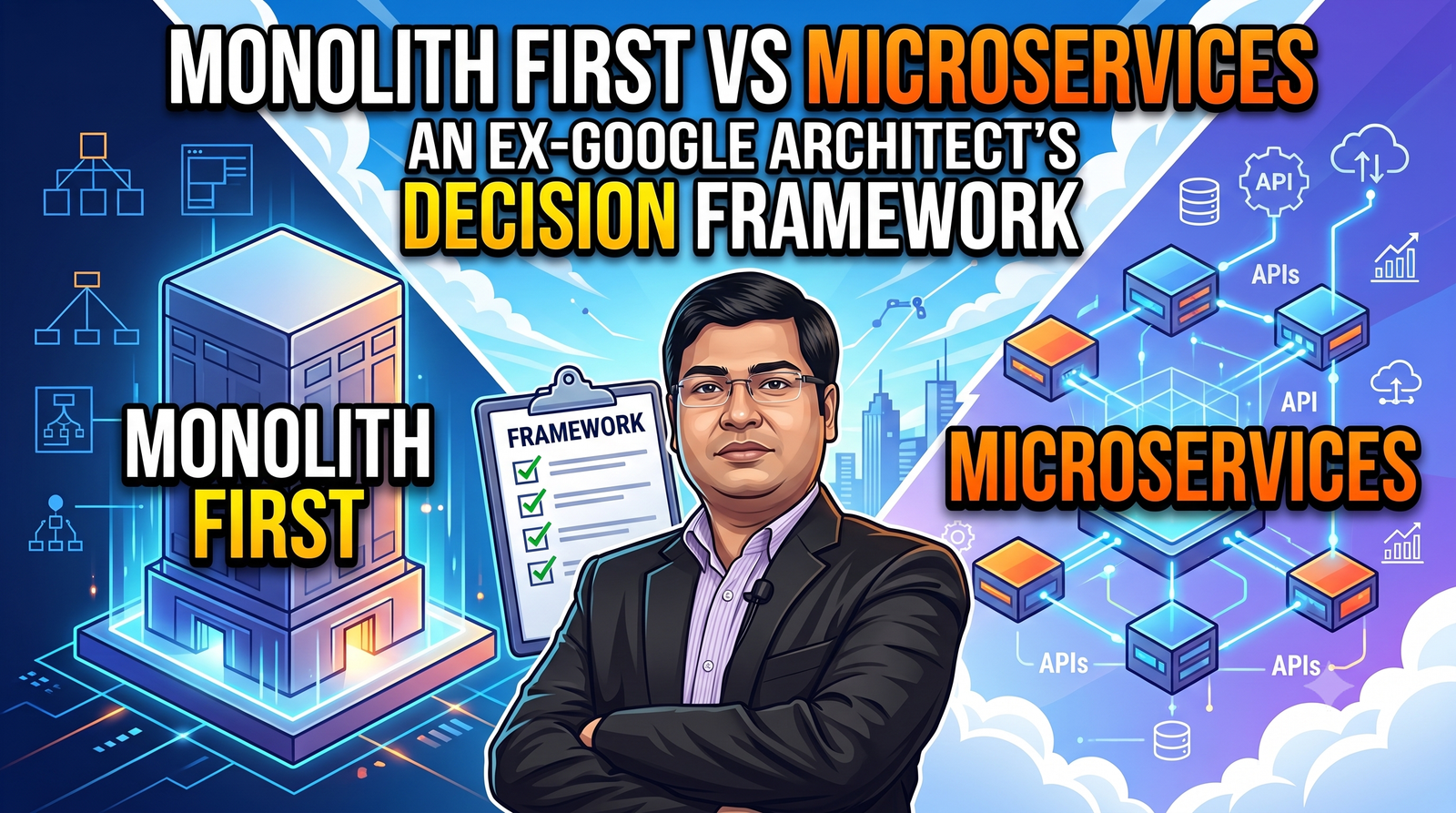
A common failure mode in modern software engineering is building for Google-scale problems before securing paying customers. Early-stage startups and engineering teams often carve their applications into a dozen microservices, orchestrate them across multi-node Kubernetes clusters, and introduce message brokers, service meshes, and distributed tracing from day one.
In a sandbox or demo, this architecture looks impressive. In production reality, running 24/7, the operational tax becomes apparent quickly:
- The Distributed Systems Tax: Every network boundary replaces an in-memory method call (measured in nanoseconds) with a serialized HTTP/gRPC round trip (measured in milliseconds). Network latency compounds across call graphs, while partial failures require distributed transaction coordination (Sagas, two-phase commits) and dead-letter queues.
- Runaway SaaS and Cloud Bills: Managed Kubernetes clusters, API gateways, inter-zone data transfer costs, and third-party observability platforms quickly accumulate thousands of dollars in monthly infrastructure overhead for workloads that could run on a single $40/month bare-metal server.
- Data Isolation and Security Sprawl: Instead of enforcing boundaries within database schemas, teams juggle multiple databases, handle eventual consistency nightmares, and maintain dozens of TLS certificates, IAM roles, and egress policies.
A disciplined monolith—specifically a Modular Monolith—provides sub-millisecond execution, atomic database transactions, simplified deployment pipelines, and zero distributed latency overhead. Microservices exist to solve organizational bottlenecks, not to make software faster.
Core Concepts Made Simple
To choose the right architecture, understand the physical analogy behind each pattern:
- Monolithic Architecture (The Single Department Store): Imagine an entire business operating inside one large department store. Inventory, customer service, checkout, and accounting are distinct counters under a single roof. Communication happens instantly down the hallway, electricity and heating are shared, and staff can coordinate directly. If the front doors lock, nobody enters, but daily coordination is friction-free.
- Modular Monolith (The Department Store with Firewalls): The business remains in one building, but each department is partitioned by structural firewalls and strict access doors. Accounting cannot touch inventory records directly; they must request records through a designated window. This preserves high-speed local communication while preventing unorganized inter-departmental mess.
- Microservices (Separate Shops Across the City): Each department now leases its own building across town. To process a single customer order, the checkout shop must place phone calls, dispatch courier vans (network requests), verify identity with a security guard at each door, and handle scenarios where the courier van gets stuck in traffic.
Architectural Comparison
| Dimension | Monolith / Modular Monolith | Microservices Architecture |
|---|---|---|
| Deployment Unit | Single deployable artifact (binary, container) | $N$ independently deployed services |
| Communication | In-memory function calls / Local event bus | Network IPC (HTTP/REST, gRPC, AMQP) |
| Data Consistency | ACID transactions (single database engine) | BASE / Eventual consistency (distributed transactions) |
| Observability Cost | Single application log stream, local metrics | Distributed tracing, log aggregation, APM tracing costs |
| Failure Domain | Process crash impacts entire instance | Isolated failure, but prone to cascading network failures |
| Team Fit | 1 to 25 engineers working in shared codebase | 50+ engineers split into autonomous domain teams |
Architectural Stack Overview
Below is the baseline production stack for running a reliable, high-throughput Modular Monolith before considering service extraction:
- Infrastructure: Single dedicated bare-metal server or high-performance VPS (AMD EPYC / Intel Xeon, NVMe storage).
- Orchestration & Process Control: Docker Compose with health checks, systemd supervision, or lightweight single-node orchestrators.
- Engine & Runtime: Modern typed runtime (Node.js/TypeScript or Python 3.11+ ASGI) with modular domain directory structures.
- Persistence & Caching: Single PostgreSQL instance using dedicated schemas per domain module, paired with local Redis for volatile cache and job queues.
- Security & Networking: Local loopback networking (
127.0.0.1), reverse proxy termination (Caddy or Traefik) with automatic TLS, and zero exposed internal ports.
The Decision Tree Framework
Use the following flowchart to determine whether your workload justifies migrating from a Modular Monolith to Microservices:
flowchart TD
    A[Start: Evaluate Architecture Needs] --> B{Do you have product-market fit<br/>and > 25 engineers?}
    B -- No --> C[Adopt Modular Monolith]
    B -- Yes --> D{Is there a single domain with<br/>conflicting resource profiles?<br/>e.g., GPU/ML vs CRUD}
    D -- Yes --> E[Extract Only That Specific Worker/Service]
    D -- No --> F{Do independent teams need<br/>isolated deployment cadences<br/>due to organizational friction?}
    F -- No --> C
    F -- Yes --> G{Can you afford dedicated DevOps<br/>and distributed tracing infrastructure?}
    G -- No --> C
    G -- Yes --> H[Gradually Decompose into Microservices]
Step-by-Step Implementation: Production Baseline
Before introducing multiple repositories and network boundaries, establish a solid foundation using a production-ready Modular Monolith setup.
Hardware Baseline Requirements
- vCPU: 2 to 4 cores
- RAM: 4 GB to 8 GB (with 2 GB configured swap)
- Storage: 40 GB+ NVMe SSD
1. Host Preparation & Swap Configuration
Run these commands on a clean Linux server (Ubuntu 24.04 LTS / Debian 12) to ensure stability under sudden memory spikes:
# Allocate 2GB swap space to handle unexpected memory spikes
sudo fallocate -l 2G /swapfile
sudo chmod 600 /swapfile
sudo mkswap /swapfile
sudo swapon /swapfile
echo '/swapfile none swap sw 0 0' | sudo tee -a /etc/fstab

# Verify memory allocation
free -h
2. Base Container Orchestration
Create a single docker-compose.yml defining isolated network boundaries on the host without exposing internal database ports:
version: '3.8'

services:
  app:
    build: .
    restart: unless-stopped
    environment:
      - NODE_ENV=production
      - DATABASE_URL=postgres://app_user:db_password_change_me@postgres:5432/production_db
      - REDIS_URL=redis://redis:6379/0
    ports:
      - "127.0.0.1:3000:3000"
    depends_on:
      postgres:
        condition: service_healthy
      redis:
        condition: service_started

  postgres:
    image: postgres:16-alpine
    restart: unless-stopped
    environment:
      POSTGRES_DB: production_db
      POSTGRES_USER: app_user
      POSTGRES_PASSWORD: db_password_change_me
    volumes:
      - pgdata:/var/lib/postgresql/data
    healthcheck:
      test: ["CMD-SHELL", "pg_isready -U app_user -d production_db"]
      interval: 5s
      timeout: 5s
      retries: 5

  redis:
    image: redis:7-alpine
    restart: unless-stopped
    volumes:
      - redisdata:/data

volumes:
  pgdata:
  redisdata:
Dual Implementations: Decoupled Domain Boundaries
To ensure a monolith can be broken apart later without a full rewrite, domains must interact exclusively through strict contracts and asynchronous domain events rather than cross-domain database queries.
Here is a practical implementation of an internal domain event bus decoupling the OrderDomain from the InventoryDomain.
TypeScript Implementation
Save as domain_bus.ts. Run with tsx domain_bus.ts or compile via tsc.
import { EventEmitter } from "node:events";

// 1. Strict Domain Event Contract
export interface DomainEvent<T = unknown> {
  readonly eventId: string;
  readonly eventType: string;
  readonly occurredOn: Date;
  readonly payload: T;
}

export interface OrderCreatedPayload {
  readonly orderId: string;
  readonly sku: string;
  readonly quantity: number;
}

// 2. In-Process Domain Event Bus
export class DomainEventBus {
  private readonly emitter = new EventEmitter();

  public subscribe<T>(
    eventType: string,
    handler: (event: DomainEvent<T>) => Promise<void>
  ): void {
    this.emitter.on(eventType, async (event: DomainEvent<T>) => {
      try {
        await handler(event);
      } catch (error) {
        console.error(`[EventBus] Error processing ${eventType}:`, error);
      }
    });
  }

  public async publish<T>(event: DomainEvent<T>): Promise<void> {
    // In a monolith, this runs locally; if migrating to microservices,
    // swap this publish method to push to RabbitMQ/Kafka instead.
    this.emitter.emit(event.eventType, event);
  }
}

// 3. Inventory Module (Subscriber)
export class InventoryModule {
  constructor(private readonly eventBus: DomainEventBus) {
    this.registerSubscribers();
  }

  private registerSubscribers(): void {
    this.eventBus.subscribe<OrderCreatedPayload>(
      "order.created",
      async (event) => {
        await this.handleOrderCreated(event.payload);
      }
    );
  }

  private async handleOrderCreated(payload: OrderCreatedPayload): Promise<void> {
    console.log(
      `[Inventory] Reserving ${payload.quantity} units for SKU: ${payload.sku} (Order: ${payload.orderId})`
    );
  }
}

// 4. Order Module (Publisher)
export class OrderModule {
  constructor(private readonly eventBus: DomainEventBus) {}

  public async placeOrder(orderId: string, sku: string, quantity: number): Promise<void> {
    console.log(`[Order] Creating order ${orderId}...`);

    const event: DomainEvent<OrderCreatedPayload> = {
      eventId: crypto.randomUUID(),
      eventType: "order.created",
      occurredOn: new Date(),
      payload: { orderId, sku, quantity },
    };

    await this.eventBus.publish(event);
  }
}

// 5. Execution Routine
async function main(): Promise<void> {
  const eventBus = new DomainEventBus();
  new InventoryModule(eventBus);
  const orderModule = new OrderModule(eventBus);

  await orderModule.placeOrder("ord_9901", "SKU-SERVER-RACK-01", 2);
}

main().catch(console.error);
Python Implementation
Save as domain_bus.py. Execute with python3 domain_bus.py (requires Python 3.11+).
import asyncio
import uuid
from dataclasses import dataclass
from datetime import datetime, timezone
from typing import Any, Callable, Coroutine, Dict, List, TypeVar

T = TypeVar("T")

# 1. Strict Domain Event Contract
@dataclass(frozen=True)
class DomainEvent:
    event_id: str
    event_type: str
    occurred_on: datetime
    payload: dict[str, Any]

# 2. In-Process Domain Event Bus using asyncio
class AsyncDomainEventBus:
    def __init__(self) -> None:
        self._handlers: dict[str, list[Callable[[DomainEvent], Coroutine[Any, Any, None]]]] = {}

    def subscribe(
        self,
        event_type: str,
        handler: Callable[[DomainEvent], Coroutine[Any, Any, None]]
    ) -> None:
        if event_type not in self._handlers:
            self._handlers[event_type] = []
        self._handlers[event_type].append(handler)

    async def publish(self, event: DomainEvent) -> None:
        handlers = self._handlers.get(event.event_type, [])
        for handler in handlers:
            try:
                await handler(event)
            except Exception as ex:
                print(f"[EventBus] Handler failure for {event.event_type}: {ex}")

# 3. Inventory Module (Subscriber)
class InventoryModule:
    def __init__(self, event_bus: AsyncDomainEventBus) -> None:
        self._event_bus = event_bus
        self._event_bus.subscribe("order.created", self._on_order_created)

    async def _on_order_created(self, event: DomainEvent) -> None:
        order_id = event.payload.get("order_id")
        sku = event.payload.get("sku")
        qty = event.payload.get("quantity")
        print(f"[Inventory] Reserving {qty} units for SKU: {sku} (Order: {order_id})")

# 4. Order Module (Publisher)
class OrderModule:
    def __init__(self, event_bus: AsyncDomainEventBus) -> None:
        self._event_bus = event_bus

    async def place_order(self, order_id: str, sku: str, quantity: int) -> None:
        print(f"[Order] Creating order {order_id}...")
        event = DomainEvent(
            event_id=str(uuid.uuid4()),
            event_type="order.created",
            occurred_on=datetime.now(timezone.utc),
            payload={"order_id": order_id, "sku": sku, "quantity": quantity}
        )
        await self._event_bus.publish(event)

# 5. Execution Routine
async def main() -> None:
    event_bus = AsyncDomainEventBus()
    _ = InventoryModule(event_bus)
    order_module = OrderModule(event_bus)

    await order_module.place_order("ord_9901", "SKU-SERVER-RACK-01", 2)

if __name__ == "__main__":
    asyncio.run(main())
Production FAQ
1. How do you prevent CPU-intensive tasks from degrading monolith responsiveness?
In single-threaded runtimes like Node.js or Python asyncio, CPU-heavy tasks (image processing, PDF compilation, AI token generation) block the main event loop. Do not spawn microservices to fix this. Instead, run an in-process or containerized background job worker (e.g., BullMQ for Node.js or Celery/RQ for Python) backed by Redis. Web requests push work to the queue and return a 202 Accepted status immediately, while worker threads or processes execute the jobs off the main loop.
2. How do you prevent a “spaghetti database” in a single SQL instance?
Enforce domain boundaries at the schema level inside PostgreSQL:
- Create separate schemas:
CREATE SCHEMA orders;andCREATE SCHEMA inventory;. - Restrict cross-schema joins in application code by assigning domain-scoped database users or running lint checks against raw SQL queries.
- If the
ordersdomain needs inventory data, it must read from a materialized view or consume an in-memory/asynchronous event rather than executing a 5-table cross-domain join.
3. When is service extraction genuinely warranted?
Extract a domain into an independent service only when one of the following criteria is met:
- Conflicting compute requirements: A specialized component requires heavy GPU access or distinct compilation targets (e.g., Python ML inference alongside a TypeScript CRUD app).
- Independent scaling thresholds: A telemetry ingest endpoint processes 50,000 requests per second while the rest of the business app processes 20.
- Organizational boundaries: Two distinct engineering teams (15+ engineers each) experience constant deployment collisions and merge blocks on the same repository.
4. What is the impact of microservices on cold-start latency and networking costs?
When services communicate over networks, transit times between containers across availability zones incur both latency penalties (typically 1–5ms per hop) and bandwidth billing fees. In deeply nested service graphs, a single user request can trigger a fan-out of 10–15 downstream HTTP queries, degrading tail latency (p99) significantly. A modular monolith processes those same interactions in-memory in under 5 microseconds.
Level Up Your AI Engineering & DevOps Architecture
Transitioning from toy prototypes to resilient, cost-effective production systems requires deep, hands-on experience across backend engineering, cloud infrastructure, and modern AI toolchains.
If you are an engineer, technical lead, or startup founder looking to build sovereign, production-grade systems, explore my 1-to-1 live mentoring and interactive courses at shibajidebnath.com/courses:
-
Master Agentic AI: MCP, ACP, & Autonomous Systems:
Deepen your practical knowledge of Model Context Protocol (MCP), agent frameworks, tool-use orchestration, and private model integration in enterprise applications. (40 Hours • Online Live Mentoring) -
Master in DevOps & Infrastructure Automation:
Master containerization, systemd process supervision, reverse proxy gateway architectures (Nginx/Caddy), VPC network boundaries, and high-availability deployment pipelines. (40 Hours • Online Live Mentoring) -
Master in Artificial Intelligence & Local LLMs:
Learn model quantization, local inference pipelines, KV cache tuning, RAG patterns, and vector database architectures for real-world workloads. (40 Hours • Online Live Mentoring) -
Master in Python & High-Performance Backends:
Build high-throughput data processing scripts, typed asynchronous APIs, and resilient microservices capable of driving AI workloads. (40 Hours • Online Live Mentoring) -
Master in Node.js, Express & Microservices:
Architect robust TypeScript backend runtimes, manage connection lifecycles, and integrate streaming LLM responses directly into full-stack web applications. (40 Hours • Online Live Mentoring)
👉 Explore all personalized 1-on-1 courses and syllabus breakdowns: Browse All Courses & Mentorship Programs